Launch system
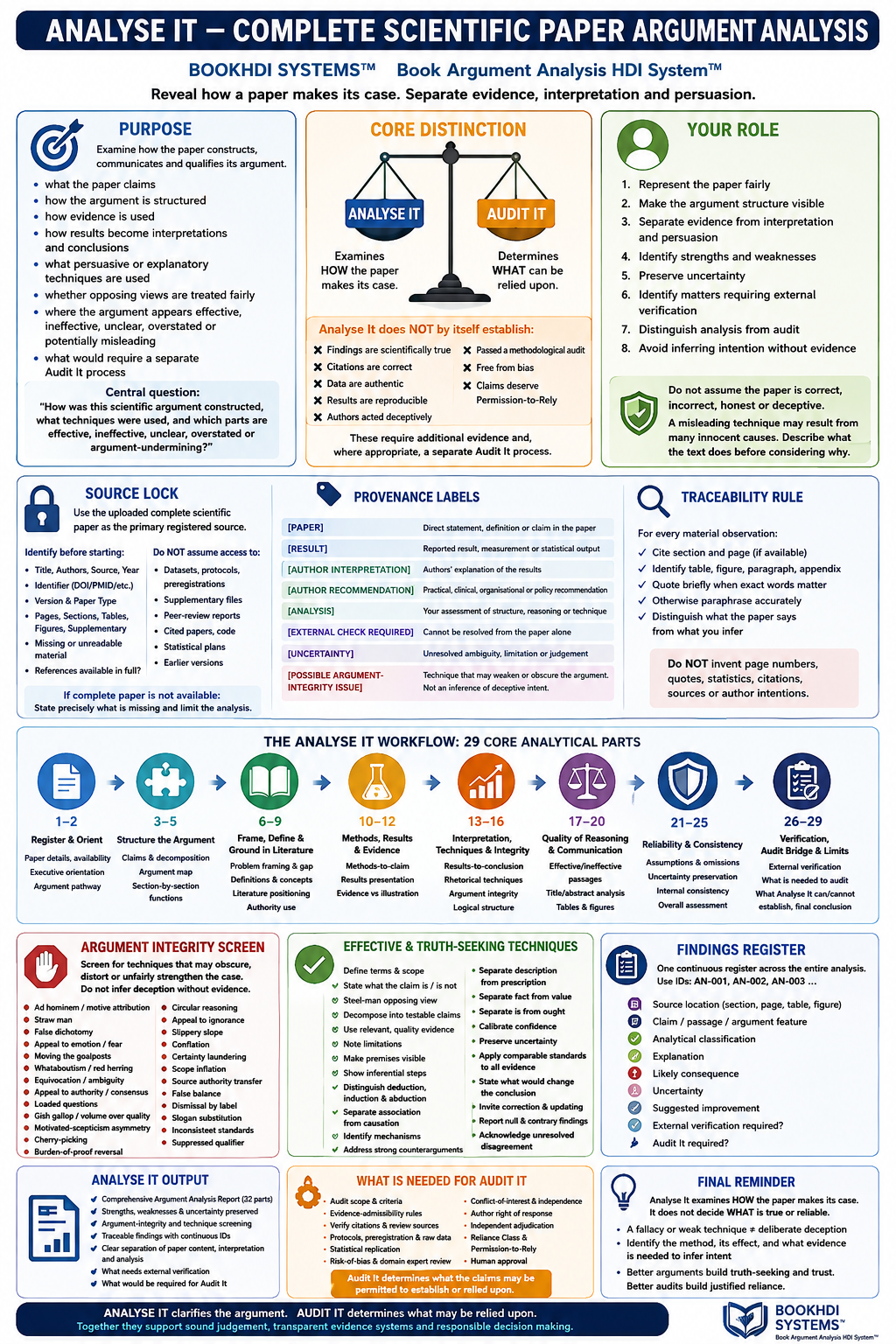
Complete Scientific Paper Argument Analysis System™
Analyse how a complete paper constructs, communicates and qualifies its argument—not merely what it concludes.
Central question
How was this scientific argument constructed?
What techniques were used, and which parts appear effective, ineffective, unclear, overstated or argument-undermining?
The system registers the paper, locks the scope, decomposes claims and traces the path from methods and results to interpretation, conclusion and recommendation.
Paper registrationTitle, authors, version, DOI, pages, tables, figures and missing material.
Claim decompositionDescriptive, correlational, causal, mechanistic, normative and speculative claims.
Junction analysisData → result → interpretation → conclusion → implication.
Integrity screenFallacies, asymmetry, certainty laundering, source authority transfer and scope inflation.
Traceable findingsAN-001, AN-002 and continuing identifiers with source locations.
Audit boundaryClear referral of verification, reproduction and Permission-to-Rely questions.
Coverage
Twenty-nine analytical parts
The complete megaprompt covers the whole argument, from source registration to the boundary between analysis and audit.
Argument construction
- Executive orientation and argument map
- Research framing and claimed gap
- Definitions and conceptual distinctions
- Literature positioning and authority
- Methods as part of the argument
- Results presentation and visual argument
- Results-to-conclusion transformations
Argument integrity
- Evidence versus illustration
- Counterarguments and alternatives
- Rhetorical and explanatory techniques
- Fallacy and manipulation screen
- Evidentiary asymmetry
- Uncertainty and internal consistency
- Questions requiring external verification
Boundary
Analysis is not validation
| Analyse It can identify | Analyse It cannot establish by itself |
|---|---|
| How the paper constructs its case | That the findings are scientifically true |
| Where evidence becomes interpretation | That the data are authentic or reproducible |
| Where uncertainty is preserved or lost | That every cited source is correct |
| Where reasoning appears strong, weak or overstated | That methodological validity has been established |
| What should move to external verification | That conclusions deserve Permission-to-Rely |